
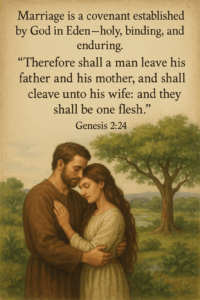
Marriage is a covenant established by God in Eden—holy, binding, and enduring.
“Therefore shall a man leave his father and his mother, and shall cleave unto his wife: and they shall be one flesh.” — Genesis 2:24.
The Unchanging Standard
Christ reaffirmed the sanctity of marriage when He said:
“What therefore God hath joined together, let not man put asunder.” — Matthew 19:6.
Only one cause was ever given for dissolving that covenant:
“Whosoever shall put away his wife, except it be for fornication, and shall marry another, committeth adultery.” — Matthew 19:9.
Any separation for lesser reasons—arguments, temper, addiction, incompatibility—may require counsel or even temporary distance, but it does not give moral right before God to form another marriage while the first partner still lives. To do so transgresses the seventh commandment.
“Thou shalt not commit adultery.” — Exodus 20:14.
The divine law never changes. It cannot be rewritten to suit modern culture or church practice. “The law of the Lord is perfect, converting the soul.” — Psalm 19:7.
The Weight of a Broken Vow
Ellen G. White wrote:
“The marriage vow is a most solemn pledge. … When the marriage ceremony is performed, the parties have covenanted to be true to each other until death shall separate them.” — Adventist Home, p. 340.
To walk away from that pledge without biblical grounds is to break faith with heaven itself. Only repentance and a turning from sin can bring peace with God.
When the Past Has Gone Wrong
Some have stumbled—through a child born outside of marriage, a home that collapsed, or a union formed on unstable ground. The gospel does not abandon such souls. Christ’s grace is stronger than our mistakes:
“If we confess our sins, he is faithful and just to forgive us our sins, and to cleanse us from all unrighteousness.” — 1 John 1:9.
Forgiveness, however, never excuses disobedience; it empowers change. True repentance means to forsake the wrong path and walk in new obedience. “When sin has separated the soul from God, it is the work of faith to lay hold on Christ and return to obedience.” — Steps to Christ, p. 64.
 Counsel to the Unmarried
Those who are single should move slowly and prayerfully. Marriage affects eternity. Do not marry for charm, appearance, or emotion alone.
“Many are unhappy in their homes because they have followed impulse rather than duty. Let their experience be a warning to others.” — Adventist Home, p. 44.
Study the Scriptures, pray earnestly, and seek divine guidance. A home founded on anything less than faith and principle will not stand.
Lessons from Eden
Adam loved his companion deeply, yet when temptation came, he chose to follow her rather than obey God. That single act of misplaced affection brought sin into the world. If Adam in his perfection fell through emotional compromise, how carefully must we guard our hearts today.
The Call to Restoration
Marriage mirrors Christ’s covenant with His church.
“Husbands, love your wives, even as Christ also loved the church, and gave himself for it.” — Ephesians 5:25.
Faithfulness in marriage reflects the faithfulness of Christ Himself. For those who have erred, the way back is open through repentance, separation from sin, and a life of purity. Heaven rejoices over every soul who returns to obedience.
 A Final Appeal
The moral law does not bend to fit the fashions of this world. Calvary proves that even one sin required the death of the Son of God; therefore no sin is trivial. God’s grace forgives, but His grace also transforms.
Hold fast to the covenant you have made. If you are single, choose prayerfully. If you have failed, confess, forsake, and let Christ restore you. Let every marriage become a witness of His redeeming love.
“Heaven looks with pleasure upon the family that is governed by the law of God, where love reigns, and where the Spirit of Christ abides.” — Adventist Home, p. 28.